30 Mar
Technological Breakthroughs and Future Directions of Chelating Agents in Daily Chemical Detergents
In modern daily chemical detergent formulations, chelating agents are indispensable functional additives. By complexing metal ions, they directly impact the cleaning efficiency and ecological safety of the detergent system. This article will systematically review the mechanism of action of chelating agents, the progress in the development of environmentally friendly products, and their practical applications.
I. Core Mechanism of Action: How Chelating Agents Enhance Cleaning Power
The core value of chelating agents lies in resolving a series of problems caused by metal ions during the washing process through specific mechanisms.
(1) Hard Water Softening: Overcoming Metal Ion Constraints
During the washing process, metal ions such as Ca2+, Mg2+, and Fe3+ in water can reduce cleaning efficiency. Chelating agents effectively block these negative processes by forming stable complexes through coordination.
(2) Antioxidant Synergy: Improving Bleaching Effectiveness
Transition metal ions accelerate the decomposition of H2O2. The presence of 1 ppm of Fe3+ can reduce bleaching efficiency by 42%. Chelating agents achieve antioxidant synergy through metal ion chelation and free radical quenching.
II. Standards and Technology Pathways for Green Chelating Agents
Traditional restricted substances like EDTA and STPP are gradually being replaced by eco-friendly alternatives. These must meet four core performance requirements.
(I) Core Performance Indicators of Environmentally Friendly Chelating Agents
Highly Efficient Chelating Ability: Strong binding for Ca2+, Mg2+, and heavy metals.
Excellent Biodegradability: Must pass OECD 301D (GLDA degradation rate >80%).
Wide Environmental Adaptability: Stable up to 170°C.
High Ecological Safety: Non-irritant and non-ecotoxic (LC50>1000 mg/L).
(II) Three Mainstream Development Technology Routes
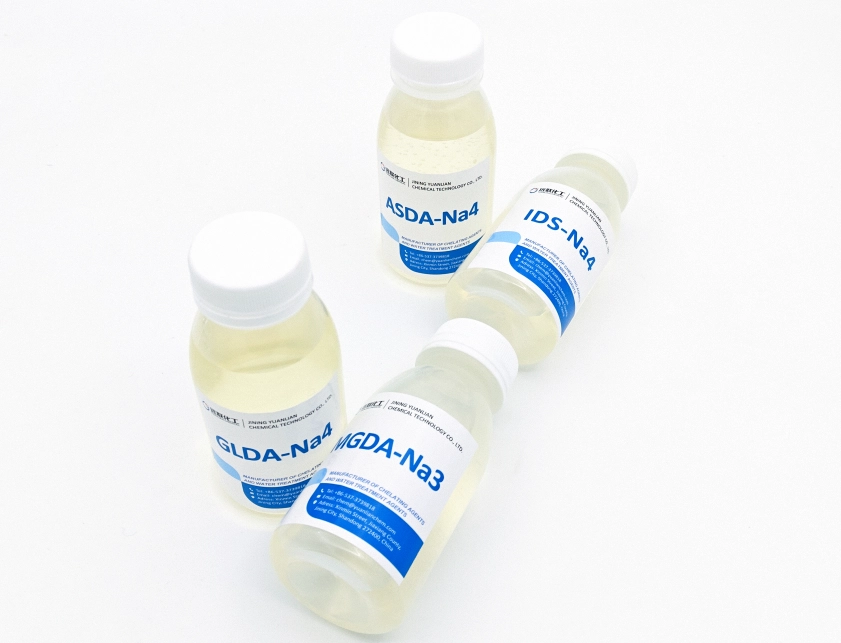
Amino Acid Derivatives (GLDA & MGDA): Produced by Shandong Yuanlian Chemical. These offer high plant-based carbon sources and 95% biodegradation in 28 days.
Natural Product Modification: Gluconate and Citrate. Low cost but require synergy with polycarboxylates.
New Synthetic Molecules (IDS): Iminodisuccinic Acid, offering EDTA-level performance with excellent biodegradability.
III. Practical Application Scenarios in Daily Cleansing Products
In daily cleaning, chelating agents significantly enhance performance through three core functions.
(I) Enhanced Soil Removal and Metal Ion Control
Chelating agents disrupt grease structures. For example, GLDA can reduce grease residue by 62% in hard water. It also inhibits catalytic deterioration, extending shelf life to 18 months.
(II) Optimizing Hard Water Softening and Washing Stability
By preventing surfactant precipitation, MGDA can improve foam stability by 41% and reduce detergent usage by 30%. In industrial boilers, it reduces scale deposition by 78%.
(III) Color Protection and Fiber Longevity
Chelating agents complex color-forming ions (Fe2+, Cu2+), reducing fading in dark fabrics by 53%. IDS can also reduce fiber friction by 18%, protecting sensitive materials like silk.
IV. Overcoming Industry Challenges: Cost vs. Performance
Despite technological leaps, the industry faces two primary bottlenecks:
Cost Disadvantage: Bio-based synthesis (GLDA/MGDA) remains more expensive than petroleum-based EDTA.
Performance Balance: Some high-degradation alternatives lack the heavy-metal binding strength required for industrial cleaning.
V. The Future of Chelation: Intelligence and Bio-Based Materials
The next 5-10 years will focus on three major breakthrough directions:
New Bio-based Materials: Lignin copolymers and marine biomass (chitosan) products.
Intelligent Response Technology: Developing photo-/thermo-responsive agents and using Machine Learning (ML) to predict critical chelation concentrations.
Full-Lifecycle Management: Blockchain traceability and online monitoring systems to meet EU Green Deal requirements.
Latest News


Need help
Prefer speaking with a human to filling out a form? call corporate office and we will connect you with a team member who can help.