Achieving the EU Ecolabel flower on industrial or consumer formulations is a decisive competitive advantage in Europe's sustainable B2B and consumer markets. However, for formulators in the industrial and institutional (I&I) cleaning, textile, and agricultural sectors, the regulatory landscape around the "builders and chelates" category is notoriously stringent.
Traditional sequestering agents like EDTA, NTA, and phosphonates face severe regulatory scrutiny under REACH and EU Ecolabel framework revisions. To maintain performance while satisfying compliance, the industry is transitioning toward readily biodegradable alternatives.
This guide evaluates the specific regulatory classifications under the EU Ecolabel criteria and analyzes how advanced green chelates—specifically Methylglycinediacetic acid (MGDA) and L-Glutamic acid N,N-diacetic acid (GLDA)—provide the exact compliance pathways required for European eco-certifications.
1. Navigating the EU Ecolabel Core Technical Criteria
To obtain the EU Ecolabel for a formulated product, every ingoing substance exceeding a concentration threshold of 0.010% by weight must be documented and compliant. For chelating agents, the regulatory hurdles center around three primary pillars:
Critical Dilution Volume (CDV)
The CDV is the primary aquatic toxicity metric used by European competent bodies. It calculates the theoretical volume of water required to dilute a dose of the product down to a non-toxic level. The equation relies heavily on data from the Detergent Ingredient Database (DID) List:
Where DF_i represents the Degradation Factor and TF_chronic_i represents the Chronic Toxicity Factor. Legacy chelates like EDTA carry highly unfavorable DF values due to their persistence, causing the formulation's total CDV to spike and frequently fail the maximum allowable limits.
Aerobic and Anaerobic Biodegradability
The EU Ecolabel demands complete ultimate aerobic biodegradation (mineralization to CO2, water, and mineral salts) within 28 days, achieving a pass level of at least 60% according to OECD 301B or equivalent testing protocols. Furthermore, strict limits are placed on Aerobically Non-Biodegradable Organics (aNBO) and Anaerobically Non-Biodegradable Organics (anNBO).
CLP Regulation Restrictions (EC No 1272/2008)
Any ingredient classified as a Substance of Very High Concern (SVHC) or labeled with specific hazard statements (such as H351 for suspected carcinogens like NTA, or severe aquatic hazards) is explicitly banned or restricted to negligible trace impurities.
2. Compliance Profiles: Traditional vs. Sustainable Chelates
When evaluating builders against EU Ecolabel criteria, chemical raw materials fall into distinct regulatory risk categories.
| Chelating Agent | Common Acronym | OECD 301B Status | EU Ecolabel Compliance Status | Primary Regulatory Constraint |
|---|---|---|---|---|
| Ethylenediaminetetraacetic acid | EDTA | Persistent / Inherent | Strictly Restricted / Banned | Accumulates in aquatic environments; fails CDV thresholds. |
| Nitrilotriacetic acid | NTA | Readily Biodegradable | Banned / Highly Restricted | Classified as a Category 2 Carcinogen (H351). |
| Methylglycinediacetic acid | MGDA | Readily Biodegradable | Fully Compliant | Low aquatic toxicity, favorable DID list factors. |
| L-Glutamic acid N,N-diacetic acid | GLDA | Readily Biodegradable | Fully Compliant | High bio-based content, excellent DID profile. |
3. Engineering Compliant Formulations with MGDA and GLDA
For global manufacturers aiming at the European marketplace, choosing the right upstream innovation partner is vital. Yuanlian Chemical, an established manufacturer specializing in high-purity biodegradable chelating agents, supplies the industry with drop-in green alternatives that streamline the EU Ecolabel dossier application process.
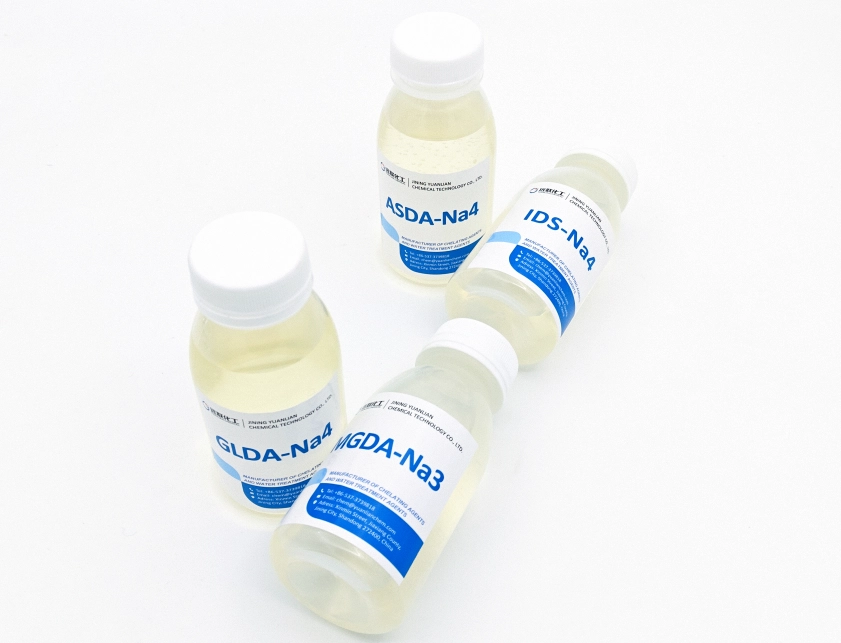
MGDA: The High-Alkalinity Builder
Trisodium MGDA is widely utilized in high-performance automatic dishwashing and heavy-duty industrial cleaning.
- Regulatory Advantage: It is classified as readily biodegradable and exhibits low chronic toxicity to fish, daphnia, and algae.
- Formulation Benefit: MGDA effectively replaces phosphates and NTA without compromising on scale inhibition, allowing laundry and I&I formulations to stay well within strict aNBO and CDV limits.
GLDA: High Solubility and Bio-Based Sourcing
Derived from sustainable monosodium glutamate (MSG), GLDA possesses a highly favorable Renewable Carbon Index (RCI).
- Regulatory Advantage: It exhibits excellent degradation profiles under both standard and high-electrolyte aquatic environments, leaving zero hazardous residues.
- Formulation Benefit: Yuanlian Chemical offers GLDA primarily as a high-purity 47% liquid solution, which demonstrates superior solubility in highly concentrated or acidic liquid formulations compared to alternative green builders. This allows European eco-labeled brands to develop compact liquid detergents that reduce transport emissions and plastic packaging waste—two additional hotspots monitored by the EU Ecolabel scheme.
4. The Path to Certification: Verification and Documentation
When compiling the technical dossier for an EU Ecolabel license submission, applicants must ensure absolute supply chain transparency. Competent bodies require:
- Valid Safety Data Sheets (SDS): Provided in strict accordance with Regulation (EC) No 1907/2006 (REACH).
- DID List Referencing: Explicitly declaring the DID number of the chelate to automate the CDV calculation spreadsheet.
- Traceability and Purity Reports: Verifying that trace heavy metals or raw material impurities remain below the strict European cut-off limits (0.0010%).
By utilizing standard, stable liquid streams of MGDA and GLDA from reliable upstream producers like Yuanlian Chemical, formulators ensure consistency in both active content and regulatory documentation, minimizing the risk of testing anomalies during the independent audit phase.
5. Strategic Conclusion
Transitioning to sustainable chelating agents is no longer an engineering compromise. By swapping persistent aminopolycarboxylates for green alternatives like MGDA and GLDA, manufacturing brands can smoothly navigate EU Ecolabel requirements. Partnering with dedicated raw material innovators ensures that industrial formulations deliver top-tier performance while maintaining unconditional compliance with Europe's premier environmental standards.