03 Jul
Replacing EDTA & Phosphates: The Superiority of MGDA-Na3 in Green Detergents
The Regulatory Push for Change
European detergent formulators are under pressure. The EU Detergent Regulation restricts phosphates in consumer products, and REACH is tightening scrutiny on persistent chelates like EDTA . Eco-label schemes such as EU Ecolabel and Nordic Swan explicitly favour readily biodegradable alternatives.
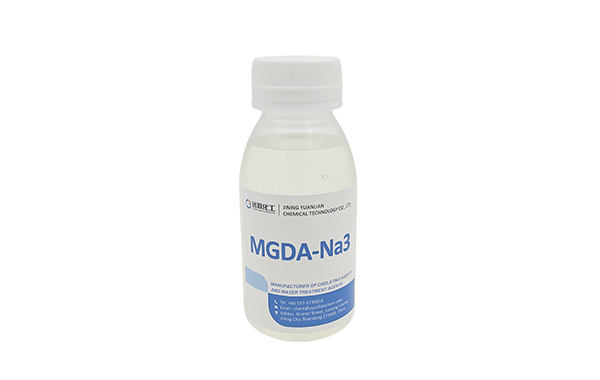
For formulators, the question is no longer whether to move away from traditional chelates, but what to use instead. MGDA-Na3 (trisodium methylglycine diacetate) has emerged as the most practical answer—a phosphorus-free, readily biodegradable chelating agent that matches or exceeds EDTA performance in most applications .
What Makes MGDA-Na3 Different
MGDA-Na3 is a low molecular weight chelating agent built around an alanine backbone . The structure is similar to NTA but with a critical difference: MGDA is non-toxic and readily biodegradable . It forms stable, water-soluble complexes with calcium, magnesium, iron, copper, and other metal ions . The small molecular size enables rapid action even at low temperatures and in short contact times .
Key properties:
| Property | MGDA-Na3 |
|---|---|
| Biodegradability | Ready (OECD 301) |
| Phosphorus-free | Yes |
| pH stability | 2–14 |
| Thermal stability | Stable to 200°C+ |
| NTA content | Typically <0.2% |
| EU Ecolabel eligible | Yes |
How MGDA-Na3 Outperforms EDTA and Phosphates
Hard Water Sequestration
In hard water, calcium and magnesium ions react with anionic surfactants and fatty acids, forming insoluble precipitates that reduce foam and leave residues on fabrics and dishes . EDTA solves this but persists in the environment. MGDA-Na3 sequesters hardness ions effectively, keeping surfactants active without the environmental trade-off .
Scale Prevention and Removal
MGDA-Na3 converts insoluble calcium carbonate and phosphate scale into water-soluble complexes . It is particularly effective against old, dried calcium stains that other chelates struggle to remove . Unlike acid-based descalers, it does not corrode equipment .
Stain Removal in Laundry
In heavy-duty laundry detergents, MGDA-Na3 is effective against stubborn stains—natural oils, sebum, blood, milk, and protein . It prevents calcium soap scum formation and redeposition on fabrics . The result: cleaner fabrics without the sour odour associated with soap scum.
Automatic Dishwashing Performance
Following global phosphate restrictions, phosphate-free automatic dishwashing formulations often suffer from reduced filming and stain removal performance . MGDA-Na3 fills this gap. It has proven highly effective in commercial phosphate-free formulations, offering efficient rinsing and superior starch stain removal—particularly against tea stains .
Bleach Stabilisation
MGDA-Na3 stabilises sodium perborate and percarbonate by chelating transition metals (iron, copper, manganese) that catalyse peroxide decomposition . This extends bleach shelf life and improves bleaching efficiency.
Soap Stabilisation
In soap-based detergents, MGDA-Na3 prevents rancidity, colour change, and dirt precipitation . This extends product shelf life and maintains appearance.
What Formulators Should Know
Replacement ratio. MGDA-Na3 can replace EDTA and phosphonates on a 1:1 active basis in most applications .
Available forms. Liquid (40% active), solid (80–85% active), or granules .
Compatibility. Works with anionic, non-ionic, and cationic surfactants, enzymes, bleaches, and preservatives .
Regulatory compliance. MGDA-Na3 is REACH-registered, NTA-free, and compliant with EU Ecolabel, Nordic Swan, and OECD 301 standards .
The Bottom Line
MGDA-Na3 is not a compromise. It is a genuinely superior choice for sustainable detergent formulations—effective calcium sequestration, scale prevention, stain removal, and ready biodegradability. For European formulators facing regulatory pressure and consumer demand, it is the practical alternative to EDTA and phosphonates.
Latest News

Need help
Prefer speaking with a human to filling out a form? call corporate office and we will connect you with a team member who can help.