25 Mar
Surfactant Compatibility: Formulating with GLDA and MGDA in Industrial Cleaning
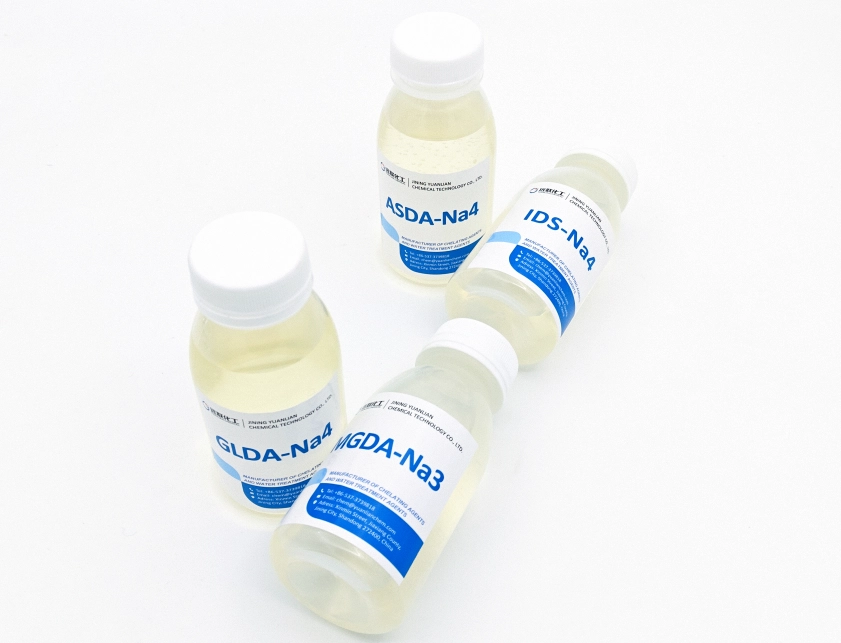
In industrial cleaning applications, Shandong Yuanlian Chemical's GLDA (tetrasodium glutamate diacetate) and MGDA (trisodium methylglycine diacetate) are next-generation green chelating agents. Their core value lies in chelating Ca2+, Mg2+, and metal ions (such as Fe3+ and Cu2+) in hard water, improving cleaning solution stability and decontamination efficiency.
The formulation strategy should focus on three key objectives: enhancing emulsification, penetration, and dispersing capabilities, adapting to various cleaning conditions (e.g., high temperature, strong alkaline), and reducing surface tension.
I. Core Principles for Formulating GLDA/MGDA with Surfactants
Functional Complementarity: GLDA/MGDA is responsible for chelating metal ions, and the formulated surfactant should address its shortcomings in emulsifying oil stains, penetrating stubborn stains, and reducing surface tension.
Adaptability to Industrial Conditions: Select a surfactant with weather resistance that matches the industrial cleaning temperature, pH (neutral/alkaline/acidic), and contaminant type (mineral oil/animal/vegetable oil/metal oxide).
Environmental Compatibility: Prioritize blending surfactants with high biodegradability to align with the environmental attributes of GLDA/MGDA (especially for compliance with EU REACH and China's "Dual Carbon" policy).
II. Anionic Surfactants: The "Workhorse" for Heavy-Duty Degreasing
Anionic surfactants are the primary blended category, suitable for most industrial cleaning scenarios. They possess strong emulsifying and detergency capabilities. Blending with GLDA/MGDA significantly enhances the removal of grease and mineral stains.
Fatty Alcohol Polyoxyethylene Ether Sulfate (AES): Best for metal degreasing and equipment spray cleaning. Offers strong emulsification and moderate foaming.
α-Olefin Sulfonate (AOS): Ideal for high-pressure spray cleaning and alkaline degreasers due to its high temperature and acid/alkali resistance.
Sodium Dodecylbenzenesulfonate (LAS): A low-cost solution for general industrial detergents; the chelating agent helps overcome LAS's poor hard water resistance.
Sodium Secondary Alkyl Sulfonate (SAS): Specifically for strong alkaline degreasers (e.g., automotive parts) due to its extreme alkali resistance.
Fatty Alcohol Ether Carboxylate (AEC): Perfect for electronic components and the food industry where high biodegradability and mildness are required.
III. Nonionic Surfactants: Enhancing Emulsification and Low-Foam Stability
Nonionic surfactants provide excellent stability against salts and acids. Combined with GLDA/MGDA, they improve the dispersion of difficult oils like lubricating or mineral oils.
AEO Series (AEO-9/AEO-3): Enhances penetration and degreasing in metal cleaning and textile applications.
Iso-Alcohol Polyoxyethylene Ether (ISO-AEO): Essential for winter formulations (low-temperature fluidity) and low-foaming mechanical parts degreasing.
TX-10/OP-10: Used for heavy industrial oil pollution (engines and bearings), though environmental alternatives like FMEE are now preferred.
FMEE-15: A high-temperature, strong alkali-resistant option for hot-rolled steel plate cleaning with superior biodegradability.
Polyethers (L61/L64): Used as defoamers or emulsifiers in high-pressure cleaning and phosphating pretreatment.
IV. Amphoteric Surfactants: Precision Cleaning and Material Protection
Amphoteric surfactants are used when high material protection is needed (precision instruments) or to reduce formula irritation.
Cocamidopropyl Betaine (CAB-35): Enhances formula stability in food-grade equipment and precision electronic cleaning.
Lauramidopropyl Hydroxysulfobetaine (LAHSB): Offers superior salt and alkali resistance for metal surface rust prevention.
V. Strategic Blend Solutions for Specific Industrial Scenarios
1. Strong Alkaline Degreasing (Steel/Automotive Parts)
Combination: MGDA (5%) + SAS-60 (8%) + FMEE (6%) + Sodium Hydroxide (10%).
Logic: MGDA prevents metal oxidation while SAS and FMEE emulsify heavy lubricants in high-temperature, high-pH spray environments.
2. Precision Cleaning of Electronic Components (Neutral pH)
Combination: GLDA (3%) + AEO-9 (4%) + CAB-35 (2%) + Isopropyl Alcohol (5%).
Logic: GLDA prevents corrosion by capturing trace metals; AEO-9 and CAB-35 provide mild but effective fingerprint and oil removal.
3. General Industrial Heavy Oil Cleaning
Combination: GLDA/MGDA Blend (4%) + AES (6%) + TX-10 (5%) + Ethanol (3%).
Logic: A versatile, cost-effective solution where the chelants solve hard water issues while the surfactants tackle mineral oil stains.
VI. Critical Considerations for Successful Compounding
pH Stability: GLDA/MGDA is most stable between pH 4-12. Avoid direct mixing with concentrated caustic soda or strong acids.
Foam Management: Use SAS or FMEE for high-pressure sprays; use AES or CAB for immersion/soaking tanks.
Regulatory Compliance: To meet EU ECOLABEL or REACH, choose AEO or FMEE over branched alkylbenzene sulfonates.
Latest News

Need help
Prefer speaking with a human to filling out a form? call corporate office and we will connect you with a team member who can help.