21 Jan
Sustainable Soil Remediation: Efficiency and Kinetics of IDS & GLDA Chelating Agents
1. Global Challenges in Soil Heavy Metal Pollution and Remediation Technologies
Heavy metal pollutants in soil enter the human body through the food chain and other channels, posing serious risks to human health. Heavy metal pollution in soil has become a global concern and urgently needs to be addressed. Research and practical application of heavy metal contaminated soil remediation technologies are key to solving this problem.
Removal and passivation are currently the main technologies for effectively addressing heavy metal pollution in soil. Among them, soil leaching technology can quickly and efficiently transfer heavy metals from the soil solid phase to the liquid phase, achieving removal, and has therefore attracted widespread attention. The key to chemical leaching is the selection of leaching agents. Traditional agents include inorganic acids, chelating agents, and surfactants. However, inorganic acids often damage soil structure, while common chelating agents (such as EDTA) remain in the soil due to poor bioavailability. Surfactants can be expensive or toxic. Therefore, there is an urgent need for environmentally friendly leaching agents with high efficiency, minimal soil damage, and low toxicity.
2. Technical Profiles of Green Chelating Agents: IDS and GLDA
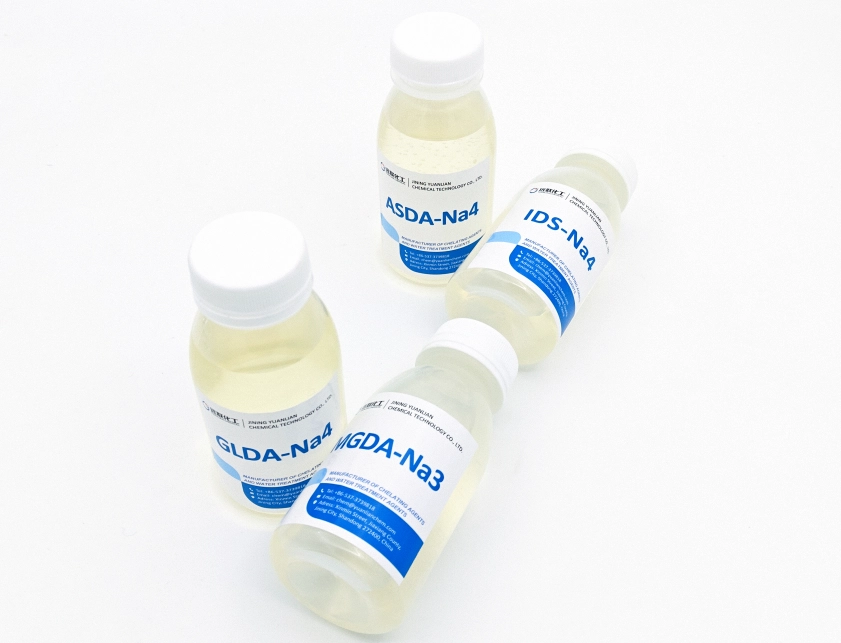
In recent years, the biodegradable chelating agents Iminodisuccinic acid (IDS) and Glutamic acid N,N-diacetic acid (GLDA) have attracted considerable attention. Studies show that IDS degrades rapidly, with 80% breaking down after just 7 days, and remains stable over a wide pH range. GLDA, produced from corn sugar fermentation using biomass as a carbon source, sees at least 60% degradation within 28 days.
IDS is considered a green chemical as it produces no wastewater or exhaust gas during production. GLDA is a green carbon atom chelator. Their strong chelating capacity for heavy metals, combined with low toxicity and excellent biodegradability, make them promising candidates for sustainable soil remediation.
3. Current Research Progress in Biodegradable Soil Leaching
BEGUM et al. conducted the first studies using IDS and GLDA for soil remediation, showing they effectively removed Cu, Cd, Zn, Ni, and Pb, serving as viable replacements for EDTA. WU et al. found high elution efficiencies for Cd, Ni, and Cu in industrial sludge, though Zn efficiency was lower. Factors such as time, pH, and concentration were found to significantly affect performance.
Research by Xu Dayong et al. demonstrated that GLDA outperforms citric acid in leaching Cd, Cu, Pb, and Ni from sewage sludge. Furthermore, Hu Zaoshi et al. showed that GLDA was more efficient than EDTA in leaching chromium at low concentrations. GLDA can also act as a chemical enhancer for phytoremediation, promoting the growth of Sedum alfredii and Solanum nigrum while improving metal extraction. These results confirm that IDS and GLDA can remove heavy metals without negatively affecting crop growth at appropriate dosages.
4. Experimental Methodology: Leaching Kinetics and Oscillation Elution
Despite their potential, reports on IDS and GLDA for soil remediation remain limited, particularly regarding leaching kinetics. In this study, the oscillation elution method was used to fit kinetics using the Elovich equation, double constant equation, and first-order kinetic equation. The research explored the effects of concentration and pH on Cd, Pb, and Zn removal and analyzed changes in heavy metal speciation before and after elution.
5. Optimization of Leaching Parameters: Time, Concentration, and pH
The study yielded the following findings regarding process optimization:
Time and Concentration: Elution efficiency increased with time (5-720 min) and concentration (0-20 mmol·L⁻¹). The Elovich and double constant equations provided the best fit for the process.
pH Effects: Efficiency followed a "bell curve" as pH increased from 3 to 10, first increasing and then decreasing.
Optimal Conditions: The optimal concentration was identified as 10 mmol·L⁻¹ at pH 5. Optimal times were 240 min for IDS and 360 min for GLDA. Under these conditions, GLDA showed greater removal ability for Cd and Pb, while IDS was more effective for Zn.
6. Impact on Heavy Metal Speciation and Environmental Risk Reduction
Analysis of soil forms showed that IDS and GLDA effectively remove the more active acid-soluble and reducible fractions of Cd, Pb, and Zn. While their ability to remove oxidizable and residual forms is limited, the significant reduction of the most mobile fractions effectively lowers the immediate environmental risk and bioavailability of heavy metals in the soil.
Partner with Yuanlian Chemical for Sustainable Remediation
At Yuanlian Chemical, we specialize in the production of high-purity, biodegradable chelating agents to support environmental protection and sustainable agriculture. Our IDS and GLDA solutions are engineered to provide maximum metal sequestration with zero environmental footprint.
Latest News
Need help
Prefer speaking with a human to filling out a form? call corporate office and we will connect you with a team member who can help.