01 Jul
Sourcing Bulk Trisodium Methylglycine Diacetate: A Buyer’s Specification Guide
Why Specification Matters in MGDA Procurement
If you are responsible for sourcing chelating agents for detergent or industrial cleaning formulations, you have probably noticed the shift. More suppliers are offering MGDA-Na3. Prices are becoming more competitive. And the quality claims are starting to blur together.
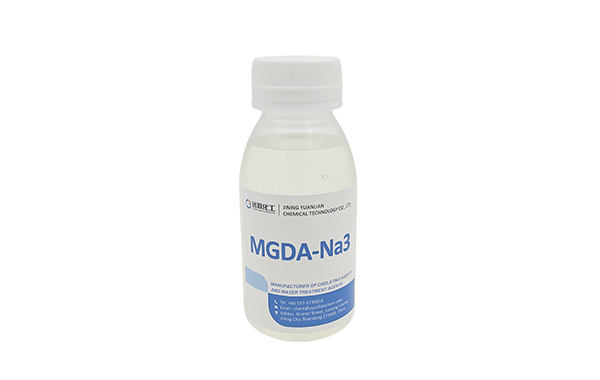
The challenge is separating reliable suppliers from the rest. MGDA-Na3 (trisodium methylglycine diacetate) has become the go-to replacement for EDTA and phosphates in many European formulations. But not all MGDA is the same . Here is what to look for when buying in bulk.
Product Forms and Active Content
MGDA-Na3 is available in several forms, and the choice affects both cost and handling.
Standard 40% liquid is the most common format for detergent applications. It blends easily into liquid formulations, is already in solution, and requires no pre-dissolution step . Some suppliers also offer 65% liquid or high-purity powder/granule (85% active) .
When comparing quotes, always calculate on active content. A 40% liquid at €1.50/kg is €3.75 per kilo of active. An 85% powder at €4.00/kg is €4.71 per kilo of active. The liquid is often cheaper per active unit .
Critical Specifications to Request
Technical data sheets all look similar. The differences are in the details.
NTA Content
This is the specification that separates responsible suppliers from the rest. NTA (nitrilotriacetic acid) is a suspected carcinogen under EU CLP (H351). Some MGDA production processes leave trace NTA as an impurity .
For EU Ecolabel or Nordic Swan applications, even trace NTA can block your application. Under REACH, NTA is listed as a Substance of Very High Concern. If a finished product contains NTA above 0.1%, the supplier has notification obligations .
Ask specifically: "What is your NTA content specification?" Responsible suppliers will have a limit—typically <0.2%—and better suppliers offer non-detectable levels .
Chlorides and Heavy Metals
These matter for corrosion protection and enzyme stability. Chlorides above 4% can accelerate corrosion on stainless steel equipment in automatic dishwashing and industrial cleaning . Heavy metals—especially iron and copper—can catalyse the decomposition of peroxides and bleaches .
Look for:
Chloride: <4%
Iron (Fe²⁺): <20 mg/L
Chelating ability: expressed as mg metal per gram of product (typical: Ca²⁺ ≥60, Cu²⁺ ≥96, Zn²⁺ ≥98)
Free Amino Acid Content
This is an indicator of production quality. Free amino acid is a by-product or unreacted raw material. High levels suggest poor process control .
For premium applications, free amino acid content should be below 0.5%, with high-quality grades achieving 0.1–0.3% . For EU Ecolabel compliance, minimising free amino acid residue supports the final formulation's environmental profile.
Biodegradability and Regulatory Compliance
MGDA is classified as "readily biodegradable" under OECD 301B, with degradation exceeding 60% within 28 days . This is the key differentiator from EDTA, which shows virtually no degradation over the same period.
REACH compliance is non-negotiable. If you are buying MGDA-Na3 from outside the EU (most production is in China), confirm that the supplier—or their EU-based "only representative"—has fulfilled registration obligations .
Packaging and Supply Chain
MGDA-Na3 is available in standard packaging that fits most industrial processes :
| Form | Packaging |
|---|---|
| Liquid (40–65%) | 200–250 kg drums, 1000–1250 kg IBCs |
| Powder/Granule (85%) | 25 kg bags, supersacks (500–1000 kg) |
Shelf life is typically 12 months when stored sealed in a cool, dry place away from direct sunlight. Some suppliers note that real shelf life is significantly longer under proper conditions .
Lead times for container orders from Asia are typically 4–8 weeks. European distributors may hold local stock with shorter lead times .
Red Flags to Watch For
No Certificate of Analysis available for the specific batch being quoted
Vague specifications – "high purity" without numbers means nothing
No REACH documentation – if it is coming from outside the EU and they cannot explain REACH compliance, do not buy
Price that seems too low – extremely cheap material often means low active content, high impurities, or inconsistent quality
The Bottom Line
Sourcing MGDA-Na3 is straightforward once you know what to look for. Focus on active content, NTA limits, chloride and heavy metal levels, and REACH compliance. Verify with Certificates of Analysis. And always confirm that the supplier can provide the documentation you need for EU Ecolabel or Nordic Swan audits.
The right specification makes the difference between a product that works reliably and one that creates formulation problems.
Latest News
Need help
Prefer speaking with a human to filling out a form? call corporate office and we will connect you with a team member who can help.